Woodlands Federation know that with the right teaching and support all pupils can be confident, fluent speakers able to express themselves eloquently in a range of different contexts. We know that teaching oracy improves academic outcomes, through developing skills to think critically, reason together and have the vocabulary to express our knowledge and understanding.
Intention
Woodlands Federation know that with the right teaching and support all pupils can become confident, fluent speakers able to express themselves eloquently in a range of different contexts. We know that teaching oracy improves academic outcomes, through developing skills to think critically, reason together and have the vocabulary to express one’s knowledge and understanding.
Our intention is to prepare our children for later life through weaving talk into the curriculum and embedding oracy in all aspects of the school culture. Speaking and listening opportunities are deliberate and explicitly planned to ensure all children develop the skills to listen effectively, discuss and respond with meaning, debate and disagree appropriately and explain their ideas and emotions in a coherent manner. It is our belief that developing these skills will in turn support their confidence, self –belief and courage to speak in public and share their thoughts, intellect and creativity with the world.
Implementation
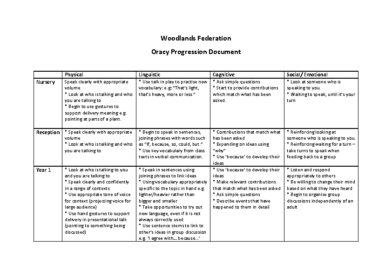
We teach oracy skills using a four-standard framework: physical, linguistic, cognitive, social and emotional, which underpin our Federation’s Oracy Skills Progression Document. This document outlines the linguistic, physical, cognitive and social/emotional skills, which are taught in each year group from Nursery to Year 6 (see Oracy Progression Document).
This enables all children to understand and develop the skills needed to be great communicators. Sentence stems, explicit vocabulary teaching, and regular opportunities to explain and challenge each other's reasoning are a part of lessons and help children to embed their learning.
All classes have key-stage appropriate talk guidelines. These are displayed in the classroom and consistently referred to whenever a pupil is engaging in any activity requiring speaking and listening skills.
As part of our school’s culture of oracy, we have expectations for talk that all our teaching staff incorporate into every lesson. These expectations are displayed in every classroom and ensure that all voices are heard, in turn developing pupils’ ability to articulate themselves in a clear, coherent manner.
Purposeful, rich opportunities for talk are planned across all subject areas. Subject leaders and class teachers collaborate on ideas for using purposeful talk effectively in the classroom and these are used across the curriculum.
These talk opportunities include presentations, debates, partner talk and group work, hot seating, discussions around key texts and performances.
Pupils develop their oracy skills outside of the classroom in the following ways: School Council, Eco Council, class assemblies; performances; playground and debates in whole school assemblies.
We adopt different strategies in class, such as kind calling out, lollipop sticks, targeted discussions to ensure every voice is heard and all children can verbally articulate their reflections on their learning.
Explicit teaching of vocabulary, clear sentence stems, meaningful talk opportunities and high-quality modelling from adults ensures all children develop their oracy skills and are fully supported to do so.
Teachers are trained and highly skilled in the implementation of oracy and whole-school CPD has been prioritised to support and develop the teaching of oracy skills across the curriculum.
Early Years
Communication and language is one of the three prime areas within the Early Years Foundation Stage. This is divided into three Early Learning Goals: Listening and Attention, Understanding and Speaking. In the Early Years, children learn the fundamental principles of dialogue, including taking turns to speak; speaking at an appropriate volume and body language for active listening, including looking at who is talking to you and showing eye contact. The children begin to use talk in meaningful partner talk, group work and class discussions. They build on their ability to articulate themselves in full sentences, using conjunctions to develop their opinions on their learning and the stories they read in class. By the end of reception, the children can offer explanations for why things might happen, making use of recently introduced vocabulary from stories, non-fiction, rhymes and poems when appropriate; with high quality modelling and support from adults.
Key Stage One and Key Stage Two
Children are assigned talk partners. A range of talk roles, sentence stems and explicit vocabulary teaching to promote meaningful conversations, which deepen understanding.
Our curriculum enables children to engage in both exploratory talk (the talk we use to explore and develop our thinking) and presentational talk (the talk we use with an audience to explain, inform or persuade). The skills needed for successful group discussion, formal debate, and speech making are also taught.
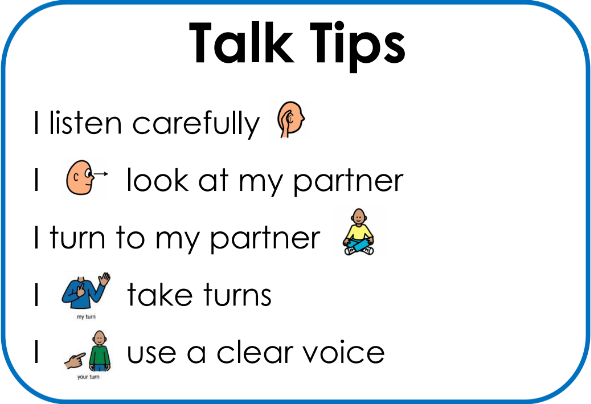
KS1 Talk Guidelines
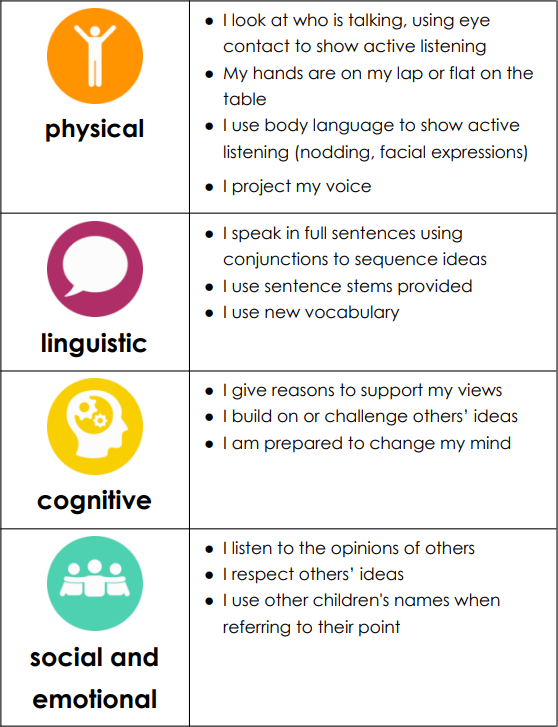
KS2 Talk Guidelines
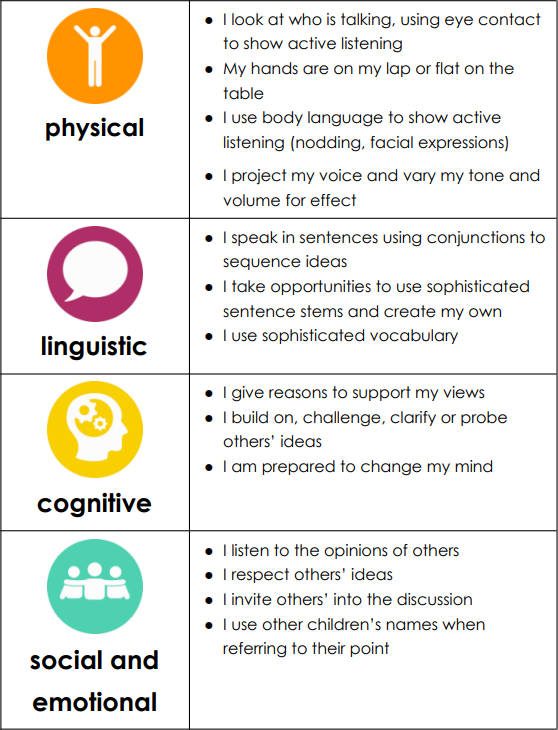
In every classroom:
- Expectations of talk are modelled by all adults.
- ‘Talk Guidelines’ are displayed and referred to.
- Key vocabulary to support with talk is displayed and used in sentence stems in planning.
- Every voice is heard through classroom strategies such as; raising hands, lollypop sticks and kind calling out.
- Talk partners are used and understand their talk roles.
- Children encouraged to speak in full sentences using specific vocabulary.
- Lessons provide opportunities for pupil-talk.
Impact
The impact of oracy being embedded into both the culture and curriculum is evident in the way our pupils articulate themselves. They are polite, eloquent and confident speakers, who engage appropriately in discussions both inside and outside of the classroom, because of the explicit teaching of talk, through high-quality talk opportunities. Children and adults consistently refer to the school talk guidelines and use these as a point of reflection on pupil progress. Teachers use the talk guidelines and the oracy skills progression document to inform their ongoing assessments of the children’s progress, provide feedback and plan for next steps.